


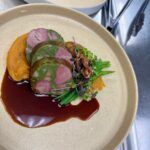
Wild Boar Tenderloin with Country Ham Mousse
Recipe courtesy of Jeremy Leinen, CEC, Executive Chef of The Country Club of Rochester
Ingredients
- Ingredients for the Ham Mousse:
- pork butt - 2.5 lbs.
- bacon - 8 ozs.
- salt - 20 gms.
- onion powder - 10 gms.
- garlic powder - 5 gms.
- TCM - 2 gms.
- sodium tripolyphosphate - 7 gms.
- pate spice/ground pickling spice - .75 tsp.
- softened butter - 3 ozs.
- chlorphyll - 100 gms.
- Benton’s ham - 3 cups, diced (blanched for 15-30 seconds to remove excess salt)
Instructions
Procedure for the Ham Mousse:
- Combine the pork, bacon, and dry seasonings, toss together and grind through a fine die.
- Add the meat mixture to the bowl of a food processor along with the softened butter and chlorophyll. Purée until smooth.
- Remove forcemeat from food process and fold in diced Benton’s ham.
Procedure for the Chlorophyll:
- Puree spinach with a bit of water in a Vitamix. Strain that through a fine chinois.
- Take the liquid that remains and bring it to a boil, then strain that through cheese cloth. The solids that remain in the cheese cloth are your chlorophyll.
- Run it under cold water quickly after straining, and it will stay nice and green.
Procedure for the Wild Boar:
- Trim the wild boar tenderloins and brine in a standard brine (1 cup salt, 1/2 cup sugar per gallon of water) for about 20 minutes.
- Sous vide at 115°F for roughly 30 minutes, just trying to gently firm the proteins up so it isn’t so 'squishy' when we are trying to form it and roll it up in the cylinder.
- Ice them down thoroughly after they come out of the water bath before proceeding.
Assembly:
- Pat the wild board tenderloins dry.
- Have the forcemeat in a piping bag with the tip cut to an appropriate size and have transglutaminase at the ready, along with caul fat. I like to use a half cylinder mold for preparations like this, but you can free form if you don’t have one or just prefer to work without it. You’ll also need plastic wrap and either string to tie off the ends or some zip ties.
- Lay the plastic down first, lining the mold. Lay the caul fat down on top of this, covering the area needed to account for the length of the boar tenderloins.
- Pipe a line of the forcemeat out on top of that, right down the middle. Then, generously dust the piped forcemeat with the transglutaminase.
- Pick out two boar tenderloins that line up nicely with each other. Generously dust them with the transglutaminase.
- Lay them in the mold snugly on top of the forcemeat. Pipe another line of forcemeat into the seam on the top side of the two boar tenderloins.
- Wrap the caul fat over the top of the meats and trim as necessary.
- Pull the plastic wrap over and gently roll the meat out of the mold and wrapping snuggly.
- Use a needle or a sausage prick to pop holes wear any air bubbles may be and firmly tie each end, compressing into a nice and even firm cylinder.
- Tie off at each end or use the zip ties.
- You can wrap it again if you feel like you need to, or vacuum seal before poaching.
- Poach at 135°F until you reach that internal temperature.
- Finish in a pan over medium heat, rolling gently to nicely brown the exterior. Slice and serve as desired.
Chef's note: This was served with buttered French beans, a spiced sweet potato puree and a glazed cipollini in the picture, all of which I’m pretty confident you don’t really need a recipe from me to make.


